

Portugal
D8 Digital Nomad Residence Visa: health insurance requirements
Yes: health insurance is required
Yes. Portugal's D8 Digital Nomad Visa requires health insurance with at least €30 000 of coverage, valid across the Schengen Area, including emergency care, repatriation, and the full visa period. Travel insurance alone is not accepted; the cover must be issued as long-term residency-grade health insurance.
A short trip to Portugal can still use travel cover. Living there needs international health insurance that outlasts the visa.
The requirements at a glance
| Repatriation required | Yes |
|---|---|
| COVID-19 cover required | Not required |
| Minimum policy duration | Full visa period (initial 4 months, renewable into 2-year residency permit) |
| Local-licensed insurer required | No: compliant international IPMI is accepted |
| Accepted proof | Policy certificate showing ≥€30 000 coverage, Schengen-wide validity, repatriation, in-hospital care; English or Portuguese translation |
The €30 000 floor is the Schengen visa minimum that Portugal applies to the D8. Dependents must be covered for at least the first four months of residency. International IPMI from non-Portuguese insurers is accepted as long as the certificate meets the formal requirements, unlike Spain. Primary AIMA / MNE consular page was unreachable at verification time (ECONNREFUSED / HTTP 404); cross-referenced across GetGoldenVisa, CitizenRemote, Saily, Jobbatical, and Pacific Prime.
Who qualifies for the Portugal nomad visa
The income bar is what decides most applications, and it is the number people look for first.
Here is the current one, with the conditions that come attached to it.
- Income required
- €3,680/mo or €11,040 savings
- Length of permit
- 24 monthsrenewable
- Savings alternative
- Around $12,586 in savings can be shown instead of the monthly income.
- Who can apply
- Employed remotely, Freelancer, Business owner
Income bar is 4× Portugal's minimum wage and rose for 2026. Passive income belongs to the D7 route, not D8. The €30,000 in circulation is not in the official text.
Tax
NHR ended for most new applicants in 2024; most now pay standard rates up to 48%.
That is a summary of the rule, not tax advice. Residence for immigration and residence for tax are decided separately, and the second one tends to arrive quietly, usually after you have been in the country long enough to stop thinking about it. Take proper advice before the year you need it.
What the income bar really means
Two things get people rejected on income even when they earn enough. The first is proving it: consulates want a documented, repeating history, usually bank statements and contracts covering several months, not a screenshot of a good quarter. Irregular freelance income clears the bar on average and fails on paper. The second is dependants, who almost always raise the threshold, and by a percentage of the base figure rather than a flat amount.
Treat the number above as the floor for the paperwork, not as a comfortable income for living there. It is set by the country’s own cost of living or minimum wage, which means it moves, and in several countries it is re-set every year.
Portugal's D8 Digital Nomad Visa requires at least €30 000 of health insurance, including repatriation and Schengen-wide validity, for the full visa period. International IPMI is accepted as long as the certificate meets these formal requirements.
Our take
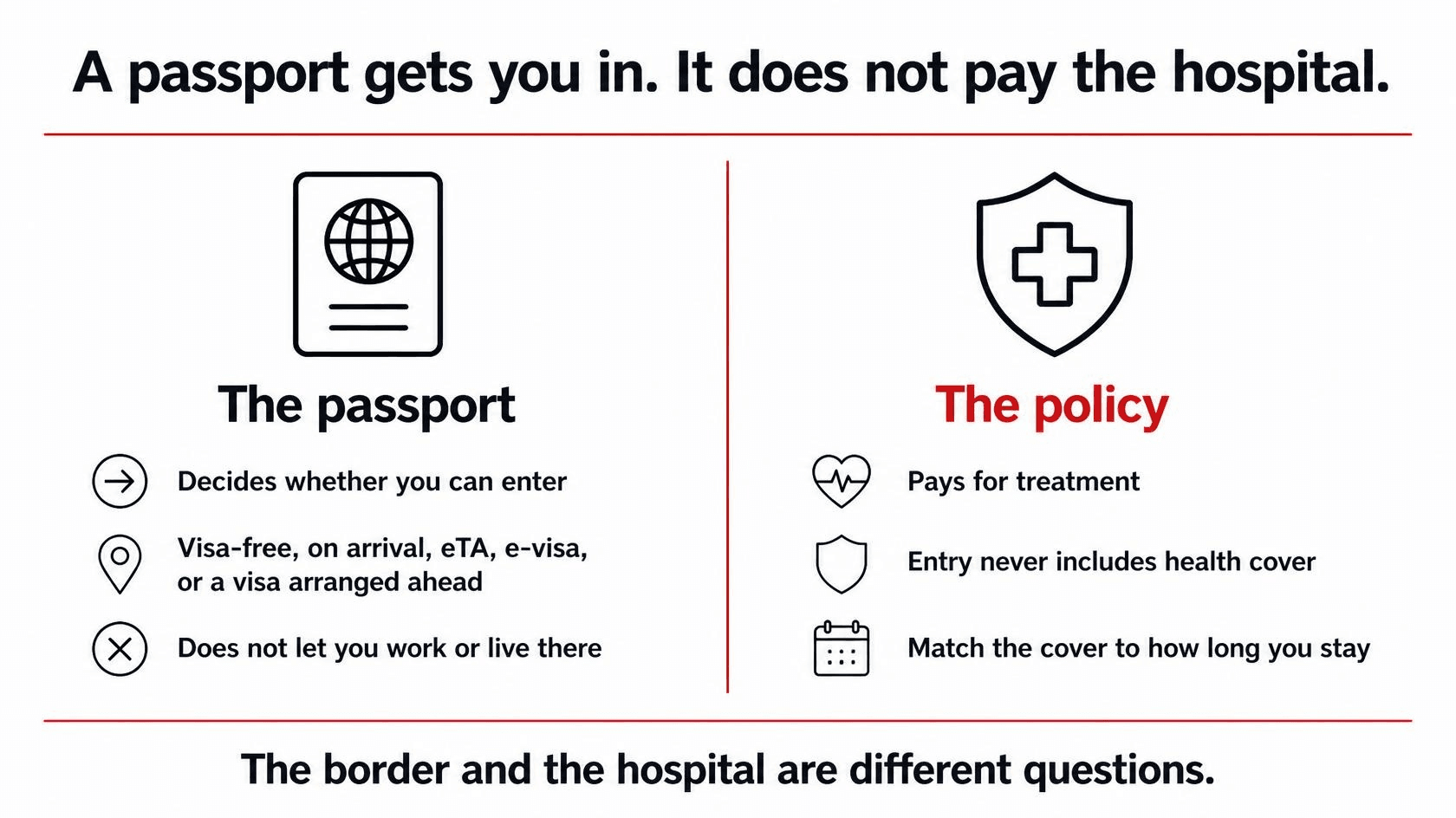
Portugal is much friendlier than Spain on insurance source: a compliant international IPMI (or a comprehensive travel-medical tier) usually works for the D8 as long as the certificate clearly shows ≥€30 000, repatriation, and the policy dates cover the visa period.
Our take: don't downgrade to a thin policy just to hit €30 000. The D8 path leads to SNS (Portugal's public health system) registration eventually, but until you have your residence certificate (CRC) and NIF-tied SNS number, your private plan is your only line. Pick coverage that works in Portuguese private hospitals (Hospital da Luz, CUF, Lusíadas) with direct billing.
What happens if you get it wrong
Visa rejection or processing delay if the policy certificate doesn't explicitly show repatriation or doesn't cover the full visa duration.
Gap between visa approval and SNS registration (typically 3–6 months) during which you are uninsured under SNS and rely entirely on your private cover.
If you bring family, dependents need their own coverage for at least the first four months, easy to miss in the application.
Interactive
Verified pricesWhat would it cost in Portugal without insurance?
A fever you assume is flu until the platelet count comes back. Common across the places nomads spend winters.
| The first doctor visit, before anyone worries | $45–$115 |
| Back again, this time to emergency | $120–$345 |
| Four nights on fluids and monitoring | $1,572–$3,444 |
| You pay, out of pocket | $1,737–$3,904 |
Priced as one lump instead of itemised, a serious admission in Portugal runs $4,000 to $16,000.
That is the bill you carry alone. Insurance exists for exactly this.
See what a match needsTypical private-care estimates for illustration, not a quote. Actual bills vary by hospital, city and severity.
FAQ
It depends on the policy variant. The certificate must show explicitly: ≥€30 000 medical coverage, repatriation included, Schengen-wide validity, and dates covering the full visa period. Many travel-insurance tiers don't meet repatriation thresholds. Verify the certificate text before submitting.
Yes, but only after you have a NIF (tax number) and your residence certificate (CRC). The typical gap from arrival to SNS access is 3–6 months. Until then your private plan is your only cover.
No. Portugal accepts compliant international IPMI policies as long as the certificate meets the formal requirements (€30 000 minimum, repatriation, validity period, Schengen coverage). This is the opposite of Spain's DNV.
No specific COVID-19 carve-out is mandated for the D8 as of 2026-05-28, though comprehensive medical cover normally includes communicable disease treatment by default.
How to apply
- Processing time
- Consular D8 visa: about 60 days by law, often longer. The AIMA residence-permit step after arrival is heavily backlogged, commonly 6 to 9 months.
- Government fee
- Around EUR 90 for the consular D8 visa, plus roughly EUR 160 to 170 for the AIMA residence permit card once in Portugal.
- Where to apply
- A Portuguese consulate or VFS centre in your country of residence for the D8 visa, then AIMA inside Portugal to convert it to a two-year residence permit. The visa must be obtained abroad first; it is a two-step process, not a tourist-entry conversion.
- 1
Get a Portuguese NIF (tax number) and open a Portuguese bank account before you apply, since the consulate wants to see means held in an account.
- 2
Book the D8 appointment at your Portuguese consulate or a VFS Global centre, then submit income proof (around EUR 3,480 a month), three months of bank statements, a remote-work contract or client proof, a criminal-record certificate, accommodation, and insurance, and pay the visa fee.
- 3
The consulate issues a D8 residency visa valid about four months with two entries; enter Portugal inside that window, not after it lapses.
- 4
Attend the AIMA appointment, often pre-scheduled when the visa is granted, to give biometrics and convert the visa into the residence permit.
- 5
Collect the two-year residence permit card by mail, and keep evidence of your address and application, because AIMA delays are common and the card can take months.
Fees and processing times move, sometimes without announcement, and a consulate can add a document the published checklist does not mention. Treat the above as the shape of the process rather than a guarantee, and check the current requirement with the mission handling your application before you book anything.
What policy actually satisfies this visa
Portugal does not publish a minimum figure, which sounds permissive and is not. It means you are judged against somebody's unwritten idea of adequate, and the safe reading of adequate is enough to cover a serious hospital admission in Portugal, not the cheapest policy that technically exists.
A compliant international policy is accepted, so you are not forced into a local insurer. That matters more than it sounds: it means one policy can follow you when you leave, instead of expiring at the border.
Repatriation of remains has to be covered explicitly. It is a line item, and either your certificate names it or it does not, and plenty of otherwise strong policies leave it out. Ask your insurer to state it.
The dates are the other thing that gets applications rejected: full visa period (initial 4 months, renewable into 2-year residency permit)
Ask your insurer for a certificate of cover that states your full name as it appears on your passport, the exact policy period, the territory covered, and the benefit amounts. That is a normal request and any decent insurer issues it without fuss. The insurance being real and the paperwork still failing is a more common way to lose an application than being uninsured.
If you will keep moving after Portugal, cover that keeps running between countries is explained in our guide to digital nomad insurance.
This page is the programme rule. It does not quote a premium and it is not a passport ranking. How we measure cost.
Get a policy that satisfies this visa
Three minutes of honest questions, then we'll match you to insurance that meets Portugal'srequirements and actually works where you're going.
Find my planIn 3 steps
- 01
Fill out
The form only asks what changes the plan.
- 02
We find your match
We compare the panel against your route, stay and visa.
- 03
Become a member
If the offer fits, you take it out directly.
Have a look if this page was not the question you came with.