Destination
Healthcare in North Macedonia, and what it costs without cover
A low-cost Balkan base with quick, English-speaking private care, but no EU reciprocal cover and one location-specific hazard: among Europe's worst winter air. Insure for repatriation, and think about respiratory cover if you stay through the smog season.
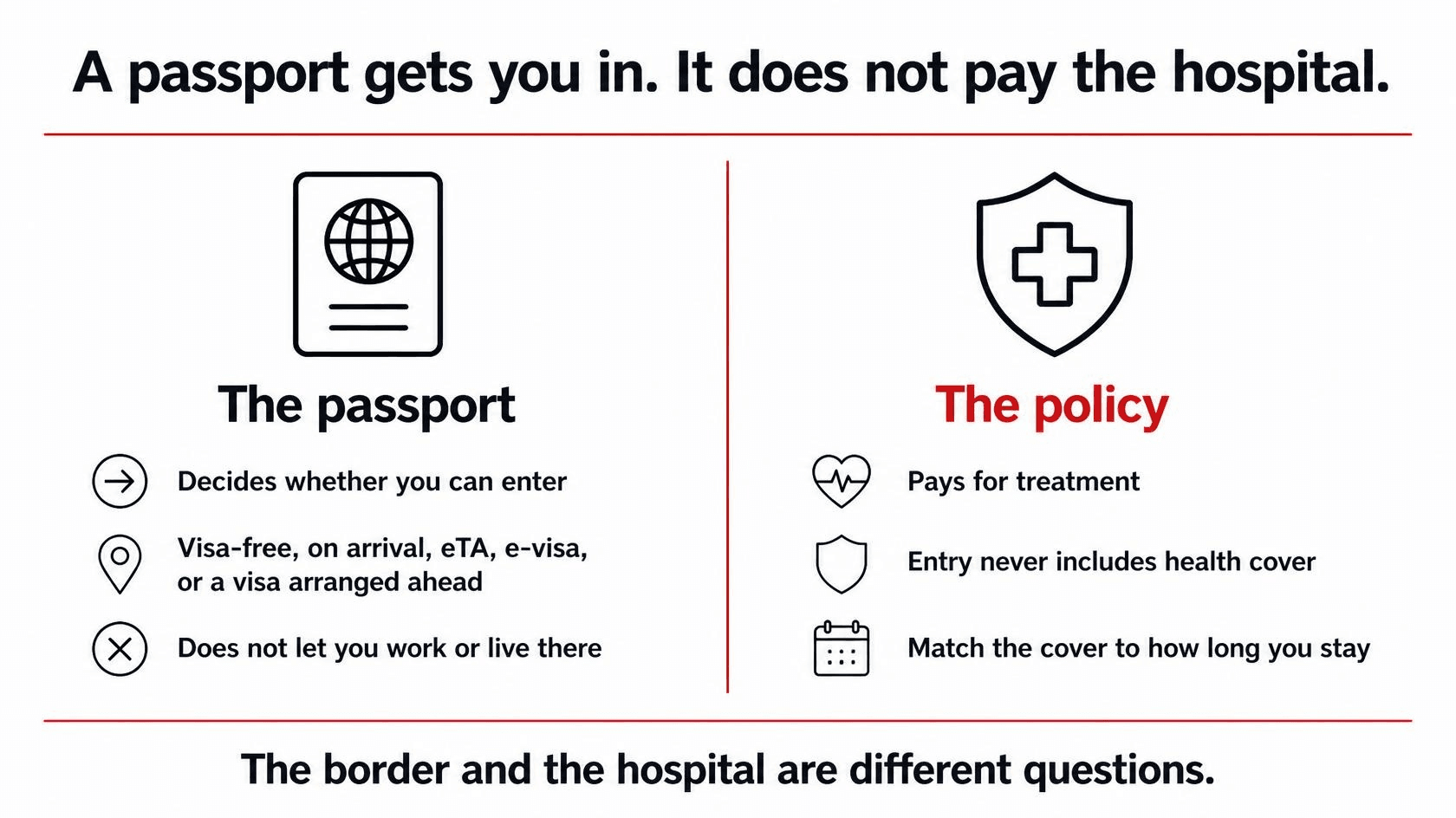
A short trip to North Macedonia can still use travel cover. Living there needs international health insurance that outlasts the visa.
- Best for Long-term nomads
- Best for Slowmads
- Best for Freelancers
- Best for Perpetual travelers
- Insurance required?
- Not required for visa-free tourist entry
- Recommended coverage
- Repatriation to Western Europe can run €50,000 to €100,000+
- Healthcare quality
- Fast, English-speaking private clinics; no EU reciprocal cover
The system
Healthcare system in North Macedonia
North Macedonia runs a mixed system.
Private hospitals in Skopje
The public side is universal but underfunded and slow, so nomads and expats lean on the private sector, where you can usually see a specialist within a day on newer equipment. Two private hospitals dominate Skopje and between them take the bulk of the market: Acibadem Sistina, the largest, covering oncology, cardiology, general surgery and fertility to international standards, and Zan Mitrev Clinic, a surgical hospital known for cardiac work. Re-Medika is the other private general hospital expats commonly name. The flagship public facility is the Clinical Centre Mother Teresa, the country's main teaching hospital, also in Skopje.
English and pharmacies
English is widely spoken at the private clinics, which is part of why foreigners default to them. Pharmacies, the apteka, are common in the cities and stock routine medicines. The practical pattern is the same one you see across the Balkans: public care exists and is cheap, but for speed, English and modern kit you go private and either self-pay or claim back.
What you'd pay
Typical costs
| Private specialist or clinic consultation | roughly 40 to 80 euros (~$45–90) |
|---|---|
| Surgery and inpatient care | into the thousands (~$1,000–10,000), though commonly cited as well below German or UK prices |
| Routine pharmacy medicines | inexpensive and widely stocked |
| Medical evacuation or repatriation to Western Europe, uninsured | a regional benchmark of roughly 50,000 to 100,000 euros (~$57,000–114,000) or more |
These are indicative figures, not an official tariff, and there is no published national price list. The currency is the Macedonian denar (MKD), pegged to the euro since 2002 at roughly 61.5 denar to 1 euro, so euro conversions stay stable, and the dollar figures shown are rough conversions for comparison. Day-to-day private care is genuinely affordable, which tempts long-stay nomads to skip cover, but that logic only holds for routine visits. The repatriation figure is the one that matters: it sits in a completely different league from any consultation, and it is the part insurance actually exists for here.
Entry & stay
Visa, residency & insurance
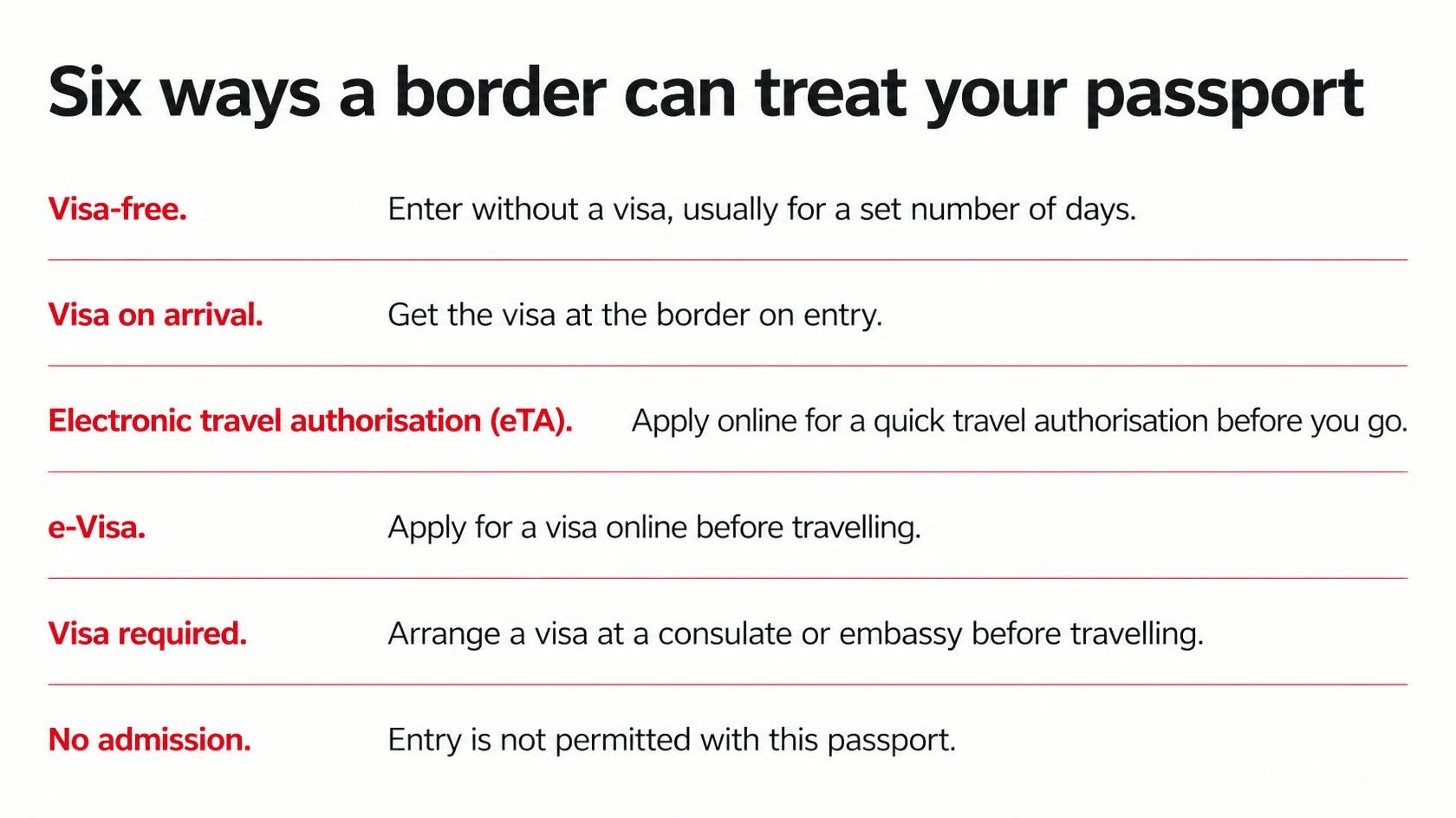
For tourism, US, British, Canadian and Australian travellers enter visa-free for up to 90 days within any 180-day period.
Visa-free tourist entry
North Macedonia is an EU candidate but is not in the EU and not in Schengen, so this 90-day clock runs independently of the Schengen one, a useful detail if you are pairing it with EU stays. Your passport should be valid for at least 90 days beyond your arrival. One easily missed rule: all foreigners must register with the local police within 48 hours of arrival, which hotels handle automatically but private or short-term rentals may not.
No nomad visa, no EU cover
There is no enacted digital nomad visa. One has been discussed and announced repeatedly since 2021, and plenty of visa-marketing sites present it as if it were live, but it has not been formally launched, so treat any such claim with suspicion. To stay beyond 90 days the standard route is a temporary residence permit, granted for work, study, family or business. Travel or health insurance is not a legal condition of visa-free tourist entry. The thing to understand is what your status does not give you: because the country sits outside the EU and the EHIC reciprocal-care system, EU nomads get no public coverage here, so private self-pay or a travel policy is the only safety net, and for anything serious that means a policy with strong evacuation and repatriation cover.
Who these rules apply to: US/EU/EEA/UK/CA/AU/NZ/JP/KR visa-free 90 days; other nationalities should verify with MFA
- Required
Visa-free short stay
90 days in 180US/EU/UK/CA/AU and 60+ other nationalities. Passport 3-6 months validity, 2 blank pages, accommodation, police registration within 48h of arrival
- Optional
Work permit
Tied to contract, typically 1 year renewableForeigners employed by North Macedonian entity or assigned by foreign employer. Job offer from registered employer, sponsorship, labor market test in some cases, passport, criminal record
- Required
Type D long-stay visa
Up to 6 months on visa; converts to TRPRemote workers and freelancers staying >90 days; pathway to temporary residence. Stable monthly income (~1,500 EUR for DN route), passport, accommodation, clean record, application via Macedonian consulate
- Required
Temporary residence permit
1 year renewable; PR after 5 continuous yearsForeigners >90 days for work, study, family, or remote work; renewable annually. Monthly income proof (~400-600 EUR baseline, higher for nomad), local address, health insurance, application to Ministry of Interior under updated Law on Foreigners (Sept 2025)
- Required
Family reunification permit
Aligned with sponsor, typically 1 year renewableSpouses, minor children, dependent parents of NM citizens or permit holders. Family relationship proof (marriage/birth certs apostilled), sponsor's residence, housing and income evidence
Visa rules change often and depend on your nationality. Always confirm with the official immigration service or your nearest consulate before you apply.
Comparing plans for a long stay in North Macedonia? Our guide to the best health insurance for nomads sets out what to check first.
Interactive
Verified pricesWhat would it cost in North Macedonia without insurance?
You pay, out of pocket
$2,100–$4,000
A serious private admission or common surgery.
Bars to scale. A flight home is in another league.
That is the bill you carry alone. Insurance exists for exactly this.
See what a match needsTypical private-care estimates for illustration, not a quote. Actual bills vary by hospital, city and severity.
Local risk notes
What to watch out for in North Macedonia
- Skopje winter air pollution.
- This is the standout local hazard. Skopje regularly ranks among the most polluted cities in Europe, and at times the world, through the cold months, when valley inversions trap smoke from heating and traffic. The 2024 average fine-particle level was several times the WHO guideline, and winter spikes go far higher, which matters a lot if you have asthma or another respiratory condition.
- Tap water in Skopje. Generally safe to drink, with city testing finding it microbiologically clean, though the water is hard and many residents still prefer filtered or bottled.
- Rabies and ticks. Rabies is present in animals, so a higher-risk traveller may want pre-exposure vaccination, and tick precautions are sensible for outdoor activity given tick-borne encephalitis in neighbouring countries.
- Petty crime. Low overall, with violent crime against foreigners rare. Pickpocketing can happen in crowded parts of Skopje, but the US advisory sits at its lowest level, exercise normal precautions.
- Driving. Roads and driving standards are mixed by Western European measure, so take the usual Balkan caution if you rent a car for trips outside the capital.
Common questions
North Macedonia insurance FAQ
No. A nomad visa has been discussed and announced repeatedly since 2021 but has not been formally enacted, despite marketing sites that present it as live. To stay beyond 90 days you use a temporary residence permit.
Up to 90 days within any 180-day period, visa-free, for US, British, Canadian and Australian passport holders. Because North Macedonia is not in Schengen, this clock is separate from any Schengen stay.
No, insurance is not a legal condition of visa-free tourist entry. But the country is outside the EU and the EHIC system, so there is no reciprocal public cover, which makes a travel or health policy the only real safety net for a serious event.
Because routine private care is cheap enough to self-pay, but a serious case needing a medical-jet repatriation to your home country can run from roughly 50,000 to over 100,000 euros, far beyond any local treatment cost.
Yes, in winter especially. Skopje ranks among Europe's most polluted cities through the cold months, with fine-particle levels several times the WHO guideline, so anyone with a respiratory condition should factor it in and consider cover for flare-ups.
In Skopje it is generally considered safe, with city testing finding it clean, though the water is hard and many people still prefer filtered or bottled.
This page is the healthcare guide. It does not quote a premium and does not name an insurer. How we measure cost.
In 3 steps
- 01
Fill out
The form only asks what changes the plan.
- 02
We find your match
We compare the panel against your route, stay and visa.
- 03
Become a member
If the offer fits, you take it out directly.
Have a look if this page was not the question you came with.