
Destination
Healthcare in South Africa, and what it costs without cover
World-class private hospitals, a remote-work visa, Cape Town, and a near-perfect European time overlap. Crime is the honest trade-off, so this guide is straight about the risk, the malaria zones, and what cover you actually need.
A short trip to South Africa can still use travel cover. Living there needs international health insurance that outlasts the visa.
- Best for Long-term nomads
- Best for Slowmads
- Best for Freelancers
- Best for Perpetual travelers
- Insurance required?
- Can be requested for the Remote Work Visa; no minimum amount published
- Recommended coverage
- Serious admission readily R100,000+; no published minimum
- Emergency number
- 10177 ambulance10111 police · 112 mobile
- Healthcare quality
- World-class private sector (Netcare, Mediclinic, Life Healthcare); strained public
The system
Healthcare system in South Africa
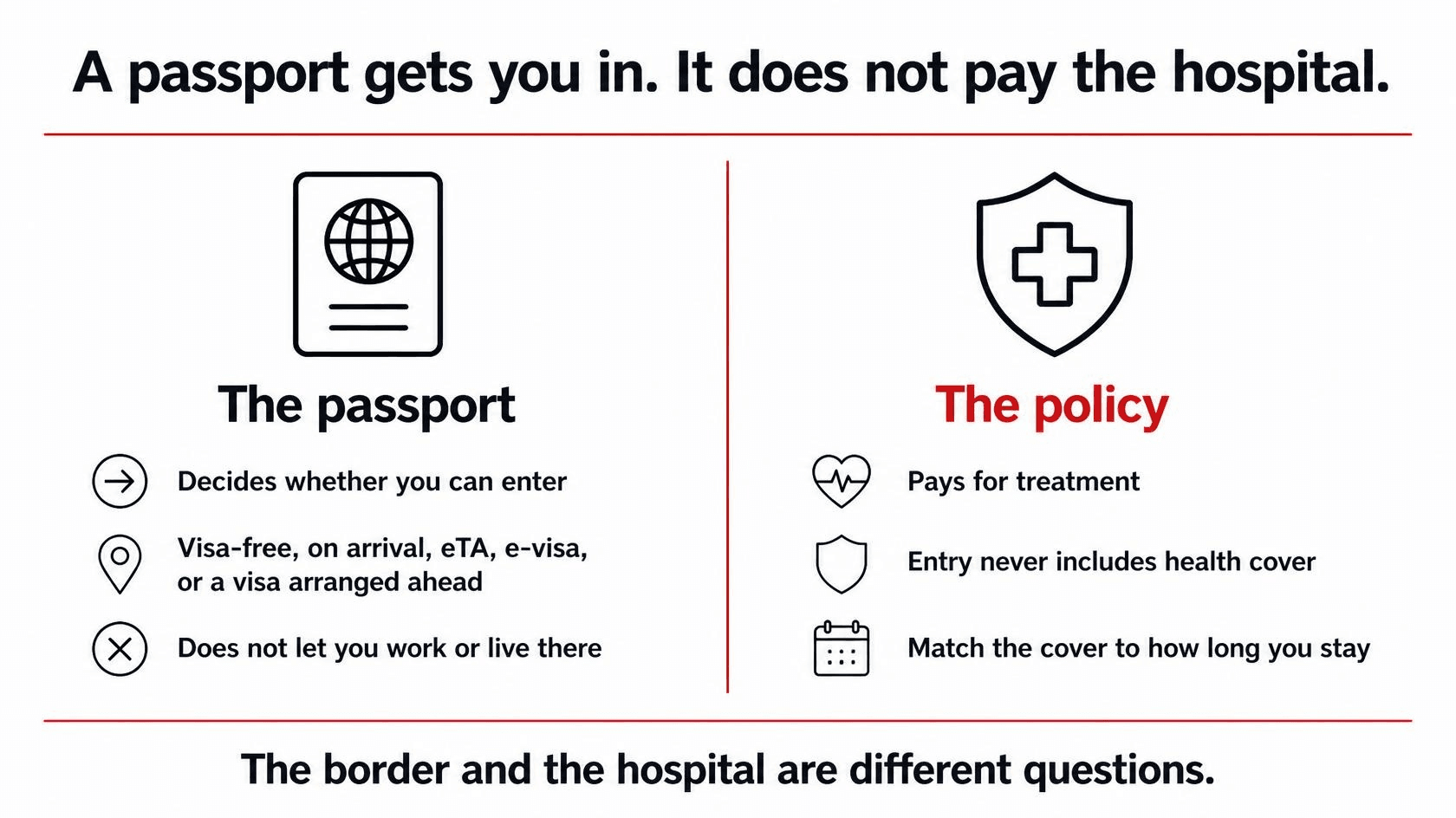
South Africa has two very different health systems.
The public sector is strained and under-resourced, with long waits, and serves most of the population. The private sector is world-class and comparable to Western standards, run by big groups, Netcare, Mediclinic and Life Healthcare, with modern hospitals in Cape Town and Johannesburg. It is where nomads will realistically get care, and it is pay-as-you-go without insurance.
Language and pharmacies
English is the working language of private healthcare, so language is not a barrier. Pharmacies are easy too: the Clicks and Dis-Chem chains are everywhere, with pharmacists who advise and dispense, and many items over the counter.
Emergency numbers
Emergency numbers are 10177 for an ambulance and 10111 for police, and 112 from any mobile reaches the nearest service free of charge; 112 is the safest single number to remember.
What you'd pay
Typical costs
| Private GP consultation | R400 to R1,000 (about $22 to $56) |
|---|---|
| Private hospital ward, per day | R1,200 to R5,000 (about $67 to $280) |
| Intensive care, per night | around R17,000 to R20,000 (about $950 to $1,100) |
| Serious admission or surgery | readily R100,000+ once theatre, specialists and scans are added |
South African private billing is itemised, so theatre, surgeon, anaesthetist and scans stack up separately and a serious admission climbs fast into the tens of thousands of rand. Care is excellent value by Western standards, but uninsured it is still a large bill, and a medical evacuation far more.
Entry & stay
Visa, residency & insurance
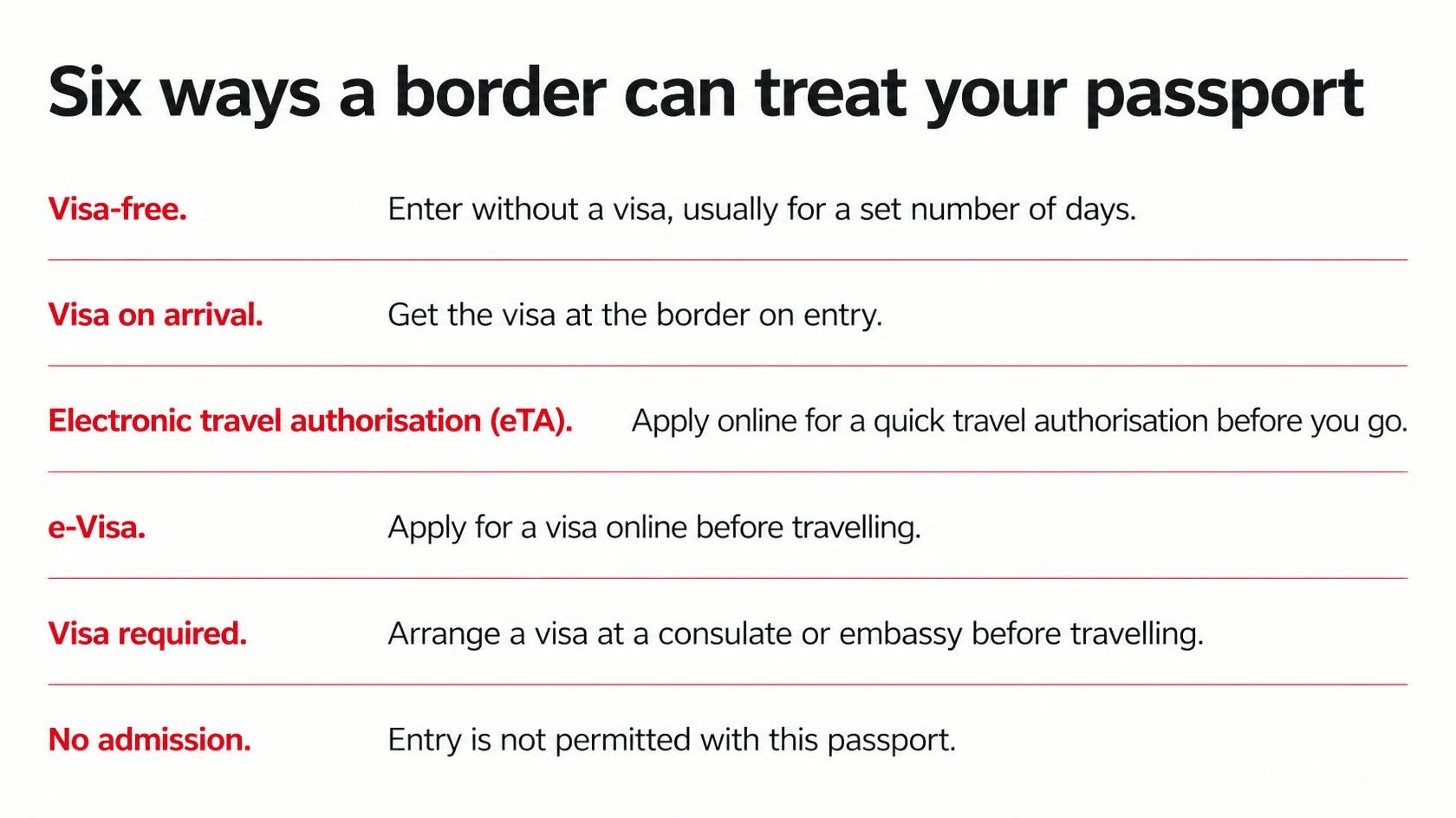
For short stays, US, British, Canadian and Australian visitors enter visa-free for up to 90 days; your passport needs at least 30 days beyond departure and a couple of blank pages, and immigration may ask for an onward ticket.
South Africa is rolling out an electronic travel authorisation, but as of 2026 it applies to visa-required nationals, not these visa-free passports. Travel insurance is not a legal entry requirement, though private-care costs make it close to essential.
Remote Work Visa
To stay and work remotely, South Africa introduced a Remote Work Visa through its 2024 immigration amendments. It is for people working for a foreign employer or clients, and the income threshold was reduced in October 2024 to ZAR 650,976 a year (around $36,000), down from the original one million rand that is still widely misquoted. It runs up to a year, renewable, to a maximum of three. Proof of health insurance can be requested as part of the application, though no minimum amount is published. There is a tax wrinkle: people from a country with a tax treaty with South Africa only register with the revenue service (SARS) if they stay over 183 days, while those from non-treaty countries register regardless. Honestly, the framework is newer than the processing, so issuing has been bedding in. We lay out the visa on the South Africa remote work visa page.
Who these rules apply to: Most visa-free entries for US/UK/EU/CA/AU/NZ/JP/KR/SG up to 90 days. Long-stay visas (Remote Work, Critical Skills, Retired Person, Section 11(6)) open to all subject to financial, qualification and police clearance
- Recommended
Visa-free entry (Port of Entry Visa)
90 days per entry (some nationalities limited to 30)Tourists and short visitors from US/UK/EU/CA/AU/NZ and other listed visa-exempt nationalities. Passport 1 month beyond departure with 2 consecutive blank visa pages per entry; onward travel; funds
- Required
Section 11(6) Visitor Visa (work endorsement)
Up to 3 years (commonly 90 days to 3 yrs at officer discretion)Foreign nationals visiting SA for short-term work with a single named employer. Letter from SA employer detailing role, duration, remuneration; passport validity; police clearance for stays >12 months; funds; cannot change employer
- Recommended
Electronic Travel Authorization (ETA)
Up to 90 days, aligned with visa-free conditionsTourists from selected nationalities (initial rollout IN/CN, expanding). Online application via DHA ETA portal (live since October 2025); valid passport; onward travel; accommodation
- Required
Critical Skills Work Visa
Up to 5 years renewable; PR pathForeign professionals in occupations on Critical Skills List (IT, engineering, healthcare, finance, AI, data science). Occupation on Critical Skills List (2022 Gazette 47182, amended 2024); SAQA-evaluated qualification (NQF 7+); professional body registration where applicable; SA employer offer/contract; min 5 yrs post-qualification experience for most roles
- Optional
Remote Work Visa (Digital Nomad Visa)
Up to 3 years; renewableForeign nationals working remotely for non-SA employer or clients. Min gross income ~37,000 USD/yr (ZAR 650,976), employment with foreign-based entity, police clearance, accommodation, 18+
- Required
Retired Person Visa
Up to 4 years renewable indefinitelyRetirees with guaranteed passive income (pension, annuity, retirement fund)
Visa rules change often and depend on your nationality. Always confirm with the official immigration service or your nearest consulate before you apply.
Comparing plans for a long stay in South Africa? Our guide to the best health insurance for a nomad visa sets out what to check first.
Interactive
Verified pricesWhat would it cost in South Africa without insurance?
The textbook traveller emergency. It cannot wait, it cannot be treated at a pharmacy, and it ends in an operating theatre.
| Emergency room, on arrival | $90–$185 |
| A scan to confirm it | $366–$1,098 |
| The operation | $2,062–$2,582 |
| Three nights recovering | $366 |
| You pay, out of pocket | $2,884–$4,231 |
Priced as one lump instead of itemised, a serious admission in South Africa runs $6,000 to $30,000.
That is the bill you carry alone. Insurance exists for exactly this.
See what a match needsTypical private-care estimates for illustration, not a quote. Actual bills vary by hospital, city and severity.
Local risk notes
What to watch out for in South Africa
- Crime, the honest headline.
- Violent crime is a real and defining consideration. The US rates South Africa "exercise increased caution" and the UK warns crime can occur anywhere, with specific risks like follow-home robberies from Johannesburg's OR Tambo airport, attacks on the route to and from Cape Town airport, and muggings of hikers on Table Mountain, Lion's Head and Signal Hill. The country recorded around 24,700 murders in 2024/25. Most nomads live well here by being deliberate, secure accommodation, e-hailing rather than walking at night, no visible valuables, but it takes more care than most destinations.
- Load-shedding. The scheduled power cuts that defined 2022 to 2023 eased dramatically, with long stretches of 2025 cut-free, but keep a power bank and a backup plan, and check your accommodation has a generator or battery.
- Malaria, in the northeast only. Risk is seasonal (roughly September to May) and limited to the low-lying northeast: the Mpumalanga lowveld including Kruger, far-northern Limpopo, and far-northern KwaZulu-Natal. Cape Town, Johannesburg and Durban are not malaria areas; take prophylaxis if you visit the parks in season.
- Roads. South Africa's roads are dangerous by international standards, with a high fatality rate and many pedestrian deaths; drive defensively and keep doors locked.
- Water. After Cape Town's 2018 "Day Zero" scare, city tap water is again treated to the national standard and generally safe to drink in Cape Town and Johannesburg, though older plumbing and rural supply vary, so bottled or filtered is a common precaution outside the well-run cities.
Common questions
South Africa insurance FAQ
Yes, a Remote Work Visa introduced in 2024 for people working for a foreign employer or clients. The income threshold is ZAR 650,976 a year (about $36,000), reduced from one million rand in late 2024. It runs up to a year, renewable to three.
Proof of health insurance can be requested as part of the application, but no minimum amount is published. Given private-care costs, insure properly regardless of the paperwork.
It takes more care than most destinations. Violent crime is a real, defining consideration, and official advisories flag specific risks. Many nomads live well in Cape Town and elsewhere by being deliberate about security, transport and where they go, but it is not a place to be casual.
Much less than it was. After a severe 2022 to 2023, 2025 saw long uninterrupted stretches, but keep a power bank and check your accommodation has a battery or generator.
Only for the low-lying northeast (the Kruger area, far-northern Limpopo and KwaZulu-Natal), seasonally. Cape Town, Johannesburg and Durban are not malaria areas.
The private sector is world-class and English-speaking, with groups like Netcare, Mediclinic and Life Healthcare. The public sector is strained, so nomads use private care, which is why cover matters.
In Cape Town and Johannesburg it is treated to the national standard and generally safe; outside the well-run cities and in rural areas, bottled or filtered is the safer choice.
This page is the healthcare guide. It does not quote a premium and does not name an insurer. How we measure cost.
In 3 steps
- 01
Fill out
The form only asks what changes the plan.
- 02
We find your match
We compare the panel against your route, stay and visa.
- 03
Become a member
If the offer fits, you take it out directly.
Have a look if this page was not the question you came with.